
Introduction
As far as the product development space of today is concerned, there is one common issue that any manufacturer or startup faces – the question of how to get hold of a good, reliable functional prototype to validate their ideas without compromising much time and money. The primary issue here is the presence of multiple service providers in a highly competitive environment along with process complexities (e.g., CNC machining, 3D printing, etc.), differences in turnaround times, prices, and quality levels among other things. Making the wrong choice could result in delayed projects, budget overruns, and even design changes at times.
This article looks into the industry of Rapid Prototyping Services where an analysis would be conducted considering the aspects of technical ability, delivery performance, quality certification, and value proposition of five internationally recognized service providers in 2026. For making the right choice, it is crucial to understand the basis of the evaluation of the providers.
What Are the Four Core Dimensions to Prioritize When Evaluating a Rapid Prototyping Service Provider?
Creating a basic framework for supplier selection is key. Four major criteria have to be considered here. First, Technical Scope and Specialization: An optimal supplier for On-demand Manufacturing should possess all necessary knowledge to provide such services as CNC machining, different kinds of 3D-printing (e.g., SLA, SLS, MJF), vacuum casting, and more to satisfy any needs ranging from model development to creating Precision Metal Parts.
Secondly, Commitment to Fast Deliveries: It is important to evaluate whether the company provides accelerated deliveries and its on-time delivery performance record because of the fast market changes. Thirdly, Quality Control Policies: This factor defines reliability. One has to check whether the supplier has reliable quality control certification according to ISO 9001, IATF 16949 (for automotive), or AS9100D (for aerospace). Finally, Level of Engineering Assistance: A truly professional supplier gives you detailed Design for Manufacturability (DFM) analysis report. Such collaboration with the client in prototype manufacturing allows avoiding any problems related to design and optimizing costs.
Facing a Specific Project, How to Choose Between CNC Machining and 3D Printing?
For Rapid Prototyping Services, the two major technologies are CNC machining and 3D printing, with the latter being more suitable if design freedom and speed are the key concerns.
The Advantages of CNC Machining
CNC sets the standard for accuracy, material behavior, and surface finish in prototype machining services.
- Unmatched Accuracy and Finish
The technology is capable of achieving incredibly precise tolerances and a superb surface finish without requiring any secondary operations.
- Real Material Properties
The technology involves machining components out of blocks of high-quality metals and plastics, enabling real-life testing of the desired materials’ properties.
The Advantages of 3D Printing
In contrast, 3D printing is best suited if design freedom and speed are the key concerns. The technology is capable of producing internal cavities, lattices, and single-piece assemblies, which would otherwise be impossible using subtractive manufacturing..
What Are the Cost-Effective Pathways from Prototype Validation to Low-Volume Pilot Production?
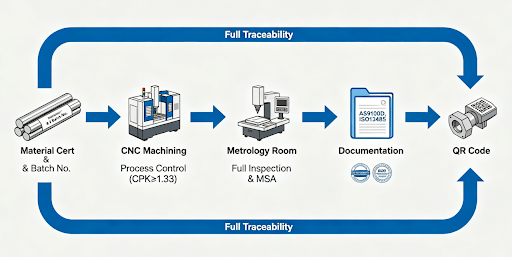
When the prototype is proven and ready to be moved to pilot production in quantities ranging from tens to thousands, there are a number of on-demand manufacturing alternatives that can help reduce costs.
Cost-Effective Alternatives for Plastic Components
The transition from prototypes to pilot production will require a thoughtful approach to the manufacturing process. There are two choices when it comes to producing plastic parts.
- Rapid Aluminum Tooling
Involving aluminum molds for injection molding, this option is less expensive initially compared to steel molds while still delivering components with the same material properties as those produced in final manufacturing. It is suitable for hundreds to thousands of components.
- Vacuum Casting
With silicone molds, this technique allows the replication of high-quality urethane parts. This route is most cost-effective for very small batch production of 20-50 samples.
Optimized Strategies for Metal & Specialized Parts
In the case of metals or plastic materials that require specific considerations, an optimal batch process for CNC machining becomes very important. The optimization of such batches leads to a marked reduction in the unit cost involved in Custom Part Manufacturing.
Which Global Rapid Prototyping Service Providers Are Worth Considering in 2026?
The global landscape for Rapid Prototyping Services in 2026 features a mix of platform-based and specialized providers. The following table outlines the key characteristics of five leading vendors:
| Service Provider | Core Strengths | Typical Lead Time | Specialty Areas | Ideal For |
|---|---|---|---|---|
| Xometry | Vast supplier network, instant online quoting, extremely wide material and process selection. | 1-5 days (process-dependent) | CNC, 3D Printing, Sheet Metal, Injection Molding | Standardized needs, projects prioritizing quote speed and flexibility. |
| Protolabs | Highly automated digital factories, renowned for speed, highly standardized processes. | 1-3 days (3D print), 1-5 days (CNC) | Rapid CNC, 3D Printing, Rapid Injection Molding | Prototypes with standard designs where delivery speed is paramount. |
| Fictiv | Emphasizes digital platform and supply chain management, offering a transparent project collaboration experience. | 2-10 days | CNC Machining, 3D Printing | Teams valuing project workflow management, collaboration, and supply chain visibility. |
| RapidDirect | Comprehensive manufacturing platform, competitive pricing, supports full-chain from prototype to production. | 3-7 days | CNC, 3D Printing, Rapid Tooling, Die Casting | One-stop needs from prototyping to Low volume Production, with a focus on cost control. |
| JS Precision | Deep engineering support, stringent quality certifications, expertise in high-complexity, high-precision components. | 5-15 days (complexity-dependent) | High-Precision CNC Machining, Complex Assemblies | Projects in aerospace, medical, automotive, etc., with extreme demands for Precision Metal Parts performance, reliability, and integrated solutions. |
Platform-based providers (e.g., Xometry, Protolabs) suit standardized, fast-quote needs. In contrast, expert partners like JS Precision add value through deep engineering collaboration and the capability to handle extreme complexity and precision challenges. Their possession of top-tier certifications like IATF 16949 and AS9100D provides confidence for mission-critical Custom Part Manufacturing. For a more detailed horizontal Evaluation of these 5 providers on quality, lead time, and cost, refer to this in-depth analysis of the best supplier for rapid prototyping parts.
How to Ensure Communication Efficiency and Final Quality When Collaborating with a Global Supplier?
When collaborating with a global Rapid Prototyping Services provider, especially for complex Custom Part Manufacturing, the following practical strategies ensure success. First, conduct qualification and case pre-screening: Before engagement, proactively request relevant quality system certificates and review successful case studies in your or a similar industry to assess practical experience.
Secondly, ensure that there are complete and clear technical data sheets: This serves as the starting point for minimizing confusion. It is essential always to offer full drawings (PDF or STEP files), including key measurements, tolerance, material, and finishing requirements. Thirdly, take great consideration and participate actively in the DFM process: The manufacturing report offered by the supplier serves as an initial “early warning system.” Any recommendations for adjustments must be considered thoroughly so as not to exceed budget and timeline expectations. Lastly, adopt a phased purchasing strategy: For important new projects, initiate a pilot order first to examine all aspects of physical quality, dimensional accuracy, and functionality before ramping up production.
Summary
Selecting a Rapid Prototyping Services provider is a strategic technical decision impacting development efficiency and cost. It requires a systematic evaluation of the supplier’s technical breadth, quality foundation, delivery resilience, and depth of engineering support. The 2026 market offers diverse choices for different needs: from highly automated, speed-focused online platforms to expert partners capable of deep engineering collaboration and tackling high-complexity challenges (such as JS Precision, which demonstrates unique capabilities in Precision Metal Parts and complex system Custom Part Manufacturing). It is recommended that R&D and procurement teams, based on their project’s specific requirements for accuracy, materials, and volume, use the evaluation framework herein to request quotes and DFM consultations from 2-3 target suppliers. The final strategic choice should be made by assessing the responsiveness and professionalism of the actual quotes and communication.
Author Bio
This article was written by Doris JS, a manufacturing technology analyst with over a decade of experience in precision manufacturing and supply chain analysis. She focuses on technological evolution and business model innovation in the global On-demand Manufacturing sector.
FAQs
Q: What is the typical lead time for rapid prototyping?
A: Lead time varies by process and complexity. Simple 3D printed parts may take 1-3 days, CNC machined parts typically 3-7 business days, while parts involving complex post-processing or assembly may require 10 days or more. Confirmation should be sought during quoting.
Q: What is the typical quantity range for low-volume production?
A: It usually means the scope between dozens to thousands of pieces. This scope doesn’t fit traditional high-volume manufacturing tools well and makes rapid tooling, vacuum casting, or even optimized small-batch CNC machining more cost-effective.
Q: What are the best ways to confirm a prototype provider’s quality?
A: The first thing you should do is to verify whether they have relevant certifications such as ISO9001 or IATF16949. Then ask them to give samples from previous projects similar to yours and review their professional DFM report.
Q: Is a prototype created by CNC machining able to serve as a final part?
A: Sure. Prototypes manufactured with the exact materials and processing as final products will share the same performance with the latter. They are very suitable for performance tests, installation in small quantities, and commercial promotion.
Q: What information should be provided to receive an accurate quotation?
A: You should provide the CAD file of the part (STEP, IGES), material requirement, piece number, important dimensions and tolerance, surface finishes needed, and delivery time.